


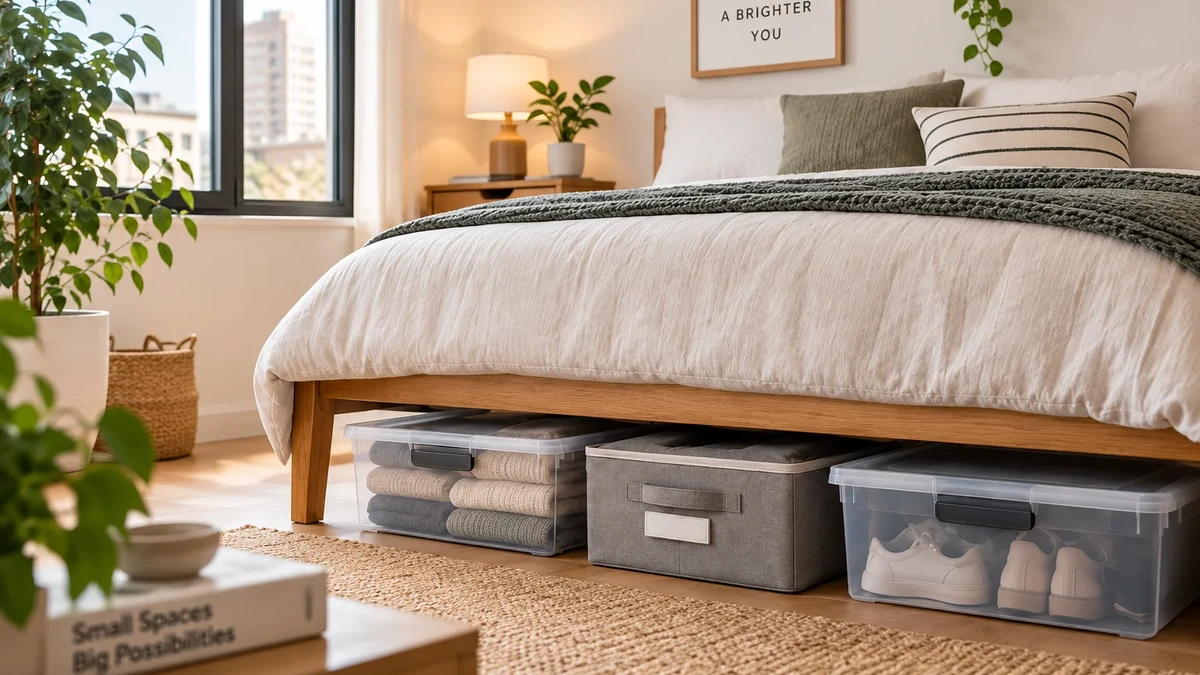
Small apartments make every inch of storage matter, and the space under your bed can be one of the most useful areas in the room. But buying the wrong storage container can leave you with a box that does not fit, is difficult to pull out, or simply creates more clutter.
The best under-bed storage container depends on four things: the clearance under your bed, what you plan to store, your flooring, and how often you need access to those items.
In this guide, we’ll break down the main types of under-bed storage, what each one is best for, and what to check before you buy—so you can choose a solution that actually works in a small apartment.
Quick Answer
For most small apartments, the best under-bed storage is the option that fits your exact clearance, protects what you store, and matches how often you need access. Low-profile rigid bins work well for dust protection, fabric cases suit clothes and bedding, and wheeled containers are useful for frequent access.
Before You Buy: Measure the Space Under Your Bed
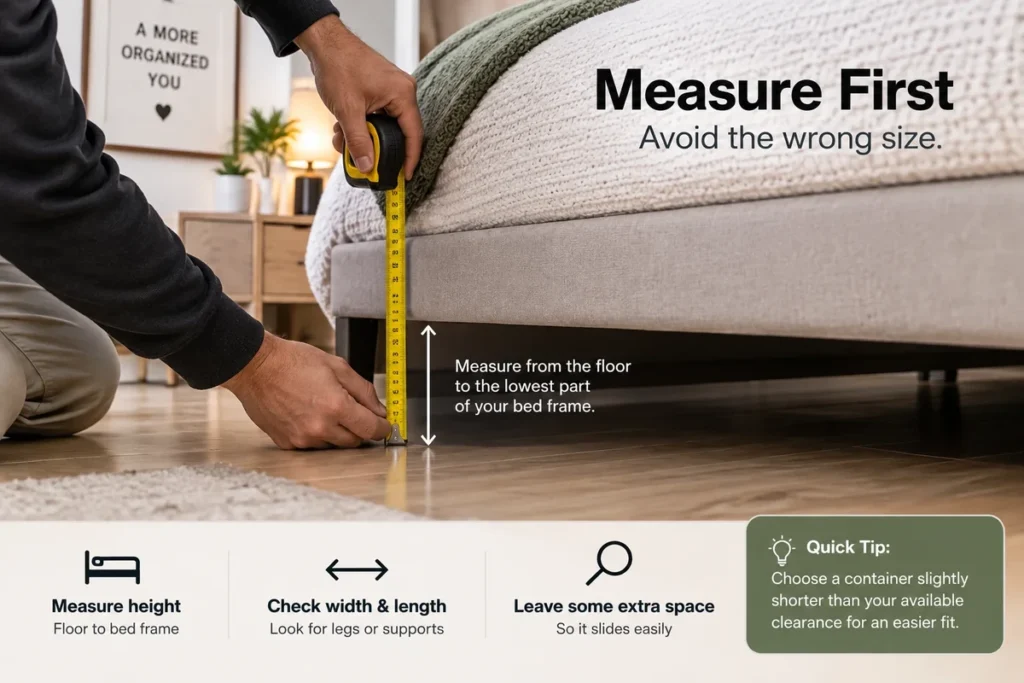
Before comparing containers, measure the vertical clearance from the floor to the lowest part of your bed frame.
Do not assume a container will fit just because it is labeled “under-bed storage.” Bed heights vary, and wheels, handles, lids, or overfilled fabric sides can add extra height.
Also measure the usable width and length under the bed. Check for center supports, legs, electrical cords, or anything else that could block a large container.
As a simple rule, choose a container slightly shorter than your available clearance instead of one that barely fits. This makes it easier to slide the container in and out.
What Type of Under-Bed Storage Is Best?
There is no single best container for every apartment. The right type depends on what you need to store.
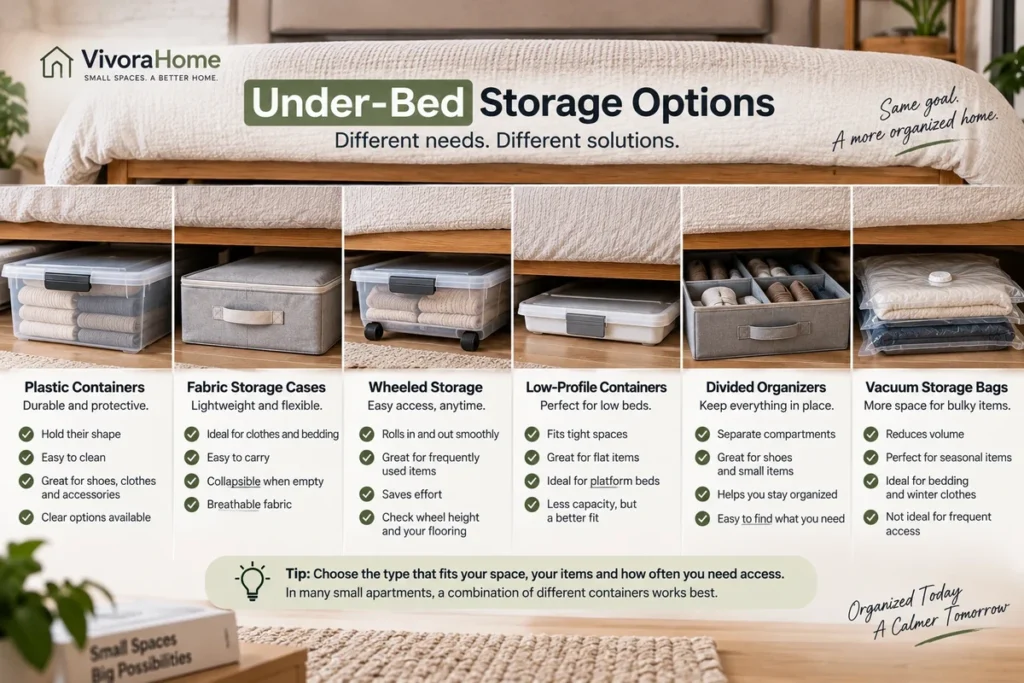
Rigid Plastic Containers
Rigid plastic boxes are a practical choice for items that need more structure and protection.
Best for:
- Shoes
- Folded clothes
- Toys
- Accessories
- Household supplies
Advantages:
- Hold their shape
- Easy to stack when not under the bed
- Many have secure lids
- Transparent versions make contents easier to identify
- Generally easier to wipe clean than fabric
Consider before buying:
Rigid boxes cannot compress to fit a tight space. Measure carefully, especially if your bed has low clearance.
Fabric Storage Cases
Fabric cases are lightweight and flexible, making them useful for clothing and bedding.
Best for:
- Seasonal clothing
- Blankets
- Sheets
- Towels
- Soft items
A product such as the IKEA SKUBB storage case illustrates this type well: it combines a zippered fabric enclosure with handles and ventilation.
Advantages:
- Lightweight
- Easier to carry
- Flexible
- Often inexpensive
- Can collapse or take up less space when empty
Consider before buying:
Fabric storage usually offers less structural protection than rigid plastic. Ventilated designs are also not airtight.
Under-Bed Storage With Wheels
Wheeled containers can be useful when you need frequent access to what is stored under the bed.
Best for:
- Frequently used clothes
- Shoes
- Children’s items
- Craft supplies
- Items you regularly rotate
Instead of lifting or dragging the entire container, you can roll it out.
Consider before buying:
Check your flooring. Small wheels may move easily on hard floors but can be less convenient on thick rugs or carpet.
Remember that wheels also add height, so include them when checking the product dimensions.
Low-Profile Storage Containers
If your bed sits close to the floor, look specifically for low-profile storage.
Best for:
- Low beds
- Platform beds
- Small amounts of clothing
- Documents or flat items
- Shoes
The trade-off is simple: a lower container usually provides less capacity.
Do not sacrifice fit just to get a larger box. A smaller container that slides easily under your bed is more useful than a large one that does not fit.
Divided Under-Bed Organizers
Some containers include adjustable compartments or dividers.
Best for:
- Shoes
- Accessories
- Children’s clothes
- Small clothing categories
- Items you want separated
Dividers can prevent everything from becoming one large pile.
However, removable fabric dividers may be less stable than rigid compartments, particularly when the organizer is moved frequently.
Vacuum Storage Bags
Vacuum bags can dramatically reduce the volume of bulky soft items.
Best for:
- Seasonal bedding
- Winter clothing
- Spare blankets
- Other compressible textiles
They can be particularly useful when storage capacity matters more than frequent access.
Consider before buying:
Vacuum bags are not ideal for items you need every day because opening, repacking, and recompressing them repeatedly becomes inconvenient.
Which Type Should You Choose?
| Your Situation | Start With |
|---|---|
| Seasonal clothes | Fabric case |
| Blankets and bedding | Fabric case or vacuum bag |
| Shoes | Rigid or divided organizer |
| Frequent access | Wheeled container |
| Low bed clearance | Low-profile container |
| Dust-sensitive items | Lidded rigid container |
| Need to see contents quickly | Clear plastic container |
| Very limited storage volume | Vacuum bags for suitable soft items |
The best solution may also be a combination. For example, you might use a rigid box for shoes and a fabric case for seasonal clothing.
What to Look for in an Under-Bed Storage Container
Height
This is the most important measurement.
Measure first and leave a little clearance so the container can move without scraping against the bed frame.
Wheels or Handles
If you access the container frequently, a good handle or wheels can make a major difference.
For occasional seasonal storage, they may be less important.
Lid or Zipper
Think about how much protection the contents need.
A secure lid is useful for items you want better protected from dust. Zippered fabric cases provide convenient closure but should not automatically be treated as airtight.
Material
Choose the material according to what you are storing.
Plastic provides more structure. Fabric provides flexibility and lower weight.
Visibility
Clear containers make it easier to identify what is inside without opening every box.
For opaque containers, simple labels can solve the same problem.
Accessibility
Do not maximize capacity at the expense of usability.
A giant box can look efficient until you have to move furniture every time you want to open it.
Common Under-Bed Storage Mistakes
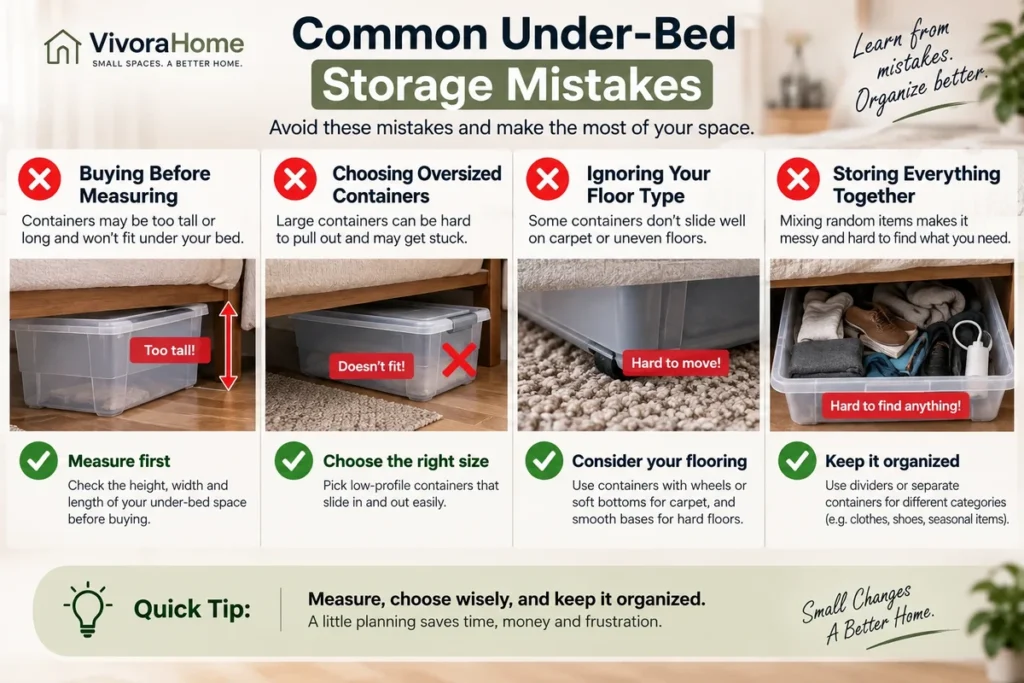
Buying Before Measuring
This is the easiest mistake to avoid.
Measure the available height, width, and length before ordering anything.
Choosing the Biggest Container Possible
Maximum capacity is not always the goal.
You still need to pull the container out, open it, and put it back comfortably.
Ignoring the Floor
Wheels that work well on a hard floor may behave differently on thick carpet.
Choose the design with your actual room in mind.
Storing Things You Never Use
Under-bed storage can become a place where forgotten belongings accumulate.
Before buying more organizers, decide whether the items are actually worth keeping.
Mixing Too Many Categories
If shoes, documents, bedding, cables, and clothes are thrown into the same large container, finding something later becomes frustrating.
Use separate containers, compartments, or labels when necessary.
What Should You Store Under the Bed?
The space is most useful for belongings that you need occasionally but still want accessible.
Good candidates include:
- Seasonal clothes
- Spare bedding
- Shoes
- Extra towels
- Bags
- Hobby supplies
- Children’s items
- Guest linens
Items used every day should generally remain somewhere easier to reach unless your under-bed storage is specifically designed for frequent access.
What Should You Avoid Storing Under the Bed?
Avoid turning the space into permanent hidden clutter.
Be cautious with:
- Food
- Liquids that could leak
- Damp items
- Fragile objects without adequate protection
- Important items you need frequently
- Anything you have forgotten about for years
The goal is to create usable storage, not simply move clutter somewhere you cannot see it.
Under-Bed Storage vs. Decluttering
Storage containers cannot solve every space problem.
If you already have several containers full of things you rarely use, adding more boxes may simply hide the real issue.
Declutter first, identify what genuinely needs storage, and then buy the smallest amount of organization equipment necessary.
This is especially important in a small apartment, where every new organizer also occupies valuable space.
How Under-Bed Storage Fits Into a Small Apartment
Under-bed storage works best as one part of a larger organization system.
If you are trying to create more space throughout your rental, combine it with unused vertical space, behind-the-door storage, cabinet organization, and narrow gaps that would otherwise remain empty.
For more ideas, read our guide:
15 Renter-Friendly Storage Ideas for Small Apartments (No Drilling)
Frequently Asked Questions
Is under-bed storage good for small apartments?
Yes. It can turn otherwise unused floor space into practical storage without requiring additional furniture. It works particularly well for seasonal clothing, bedding, shoes, and occasionally used items.
Should I choose plastic or fabric under-bed storage?
Choose based on what you store. Plastic offers more structure and is easier to wipe clean, while fabric is lighter and more flexible for clothes and bedding.
How do I know if an under-bed container will fit?
Measure from the floor to the lowest part of your bed frame, then compare that measurement with the full external height of the container, including its lid or wheels. Leaving a little extra clearance makes it easier to use.
Are wheeled under-bed containers worth it?
They can be useful if you access the contents regularly, particularly on suitable hard flooring. For items you only retrieve a few times per year, simple handles may be sufficient.
How can I keep under-bed storage organized?
Keep similar items together, use smaller categories instead of one mixed container, label opaque boxes, and periodically remove things you no longer need.
Final Thoughts
The best under-bed storage container is not necessarily the largest or most expensive one.
Start by measuring your space. Then think about what you are storing, how often you need it, and how easily the container needs to move.
For many small apartments, a simple combination of rigid boxes for structured items and fabric cases for clothing or bedding can make better use of the space you already have—without adding another piece of furniture to the room.